
RESOURCES
NDIs
Non-Destructive Inspection Systems
Non-Destructive Inspection (NDI) systems are cutting-edge technologies that allow us to examine and assess the quality of materials, components, and products without causing any damage. In openZDM, NDI is crucial for real-time defect detection, ensuring high product quality and reducing waste without disrupting the production line.
- NDI #6: Vision for surface defect detection
- NDI #7: IIoT portable laser line triangulation for gap and flush
- NDI #8: Thermal camera for glass bottle thickness measurement
- NDI #9: IR Thermal camera for early detection of welding process defects
- NDI #10: 2D Camera application for welding process monitoring (detection of aesthetic defects)
LEADING PARTNER

ASSOCIATED PARTNER: vdlwew
Description
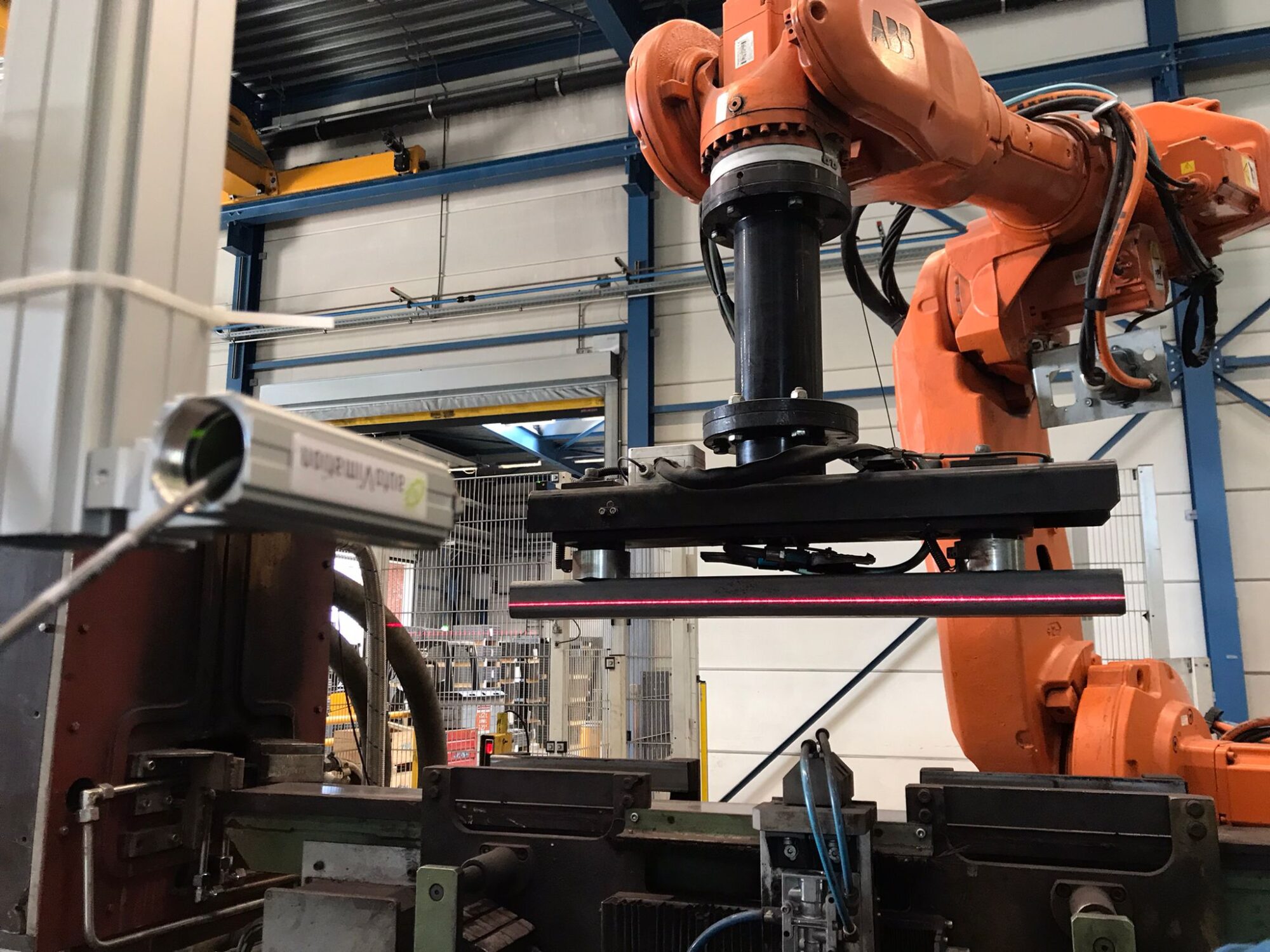
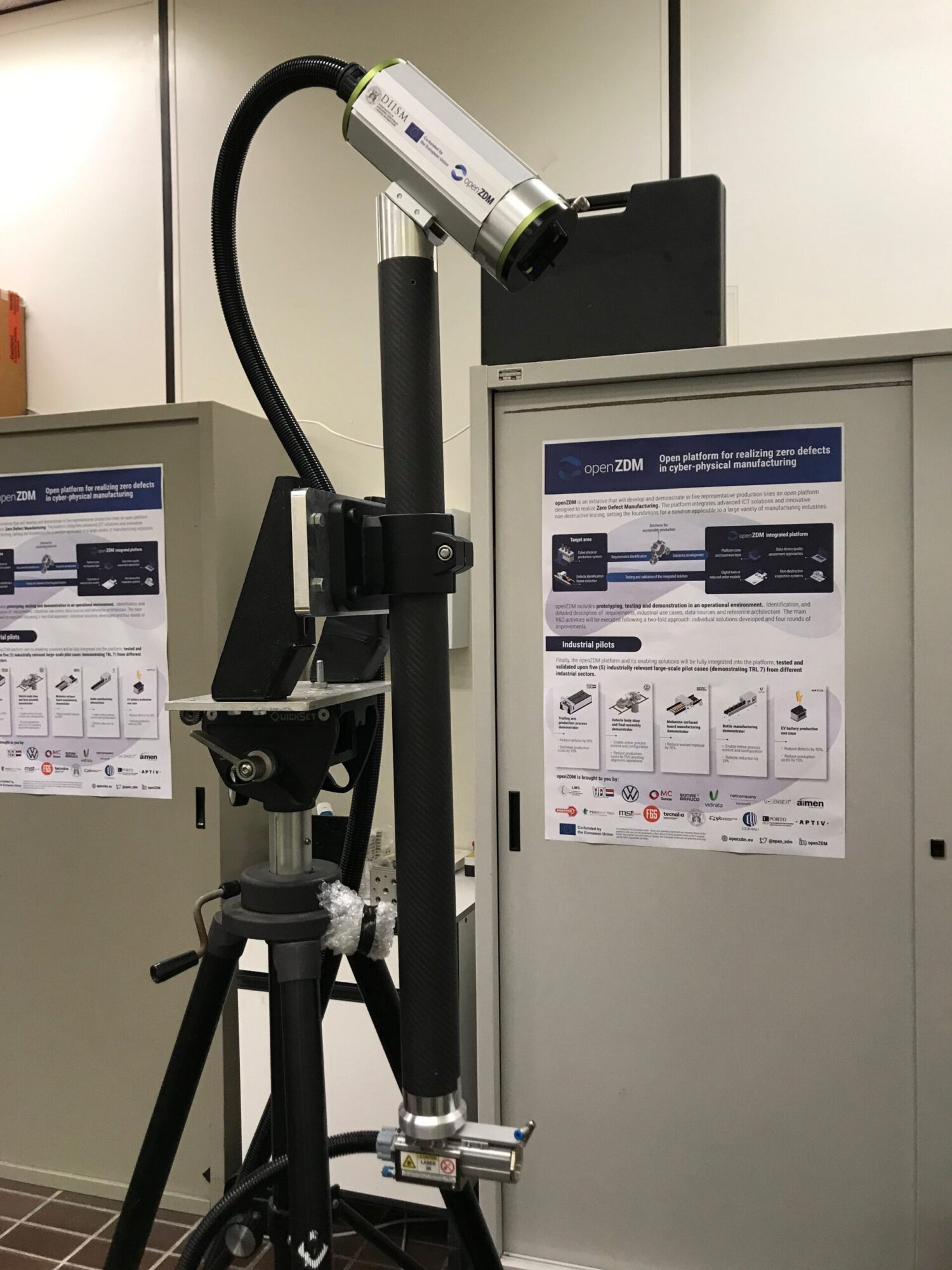
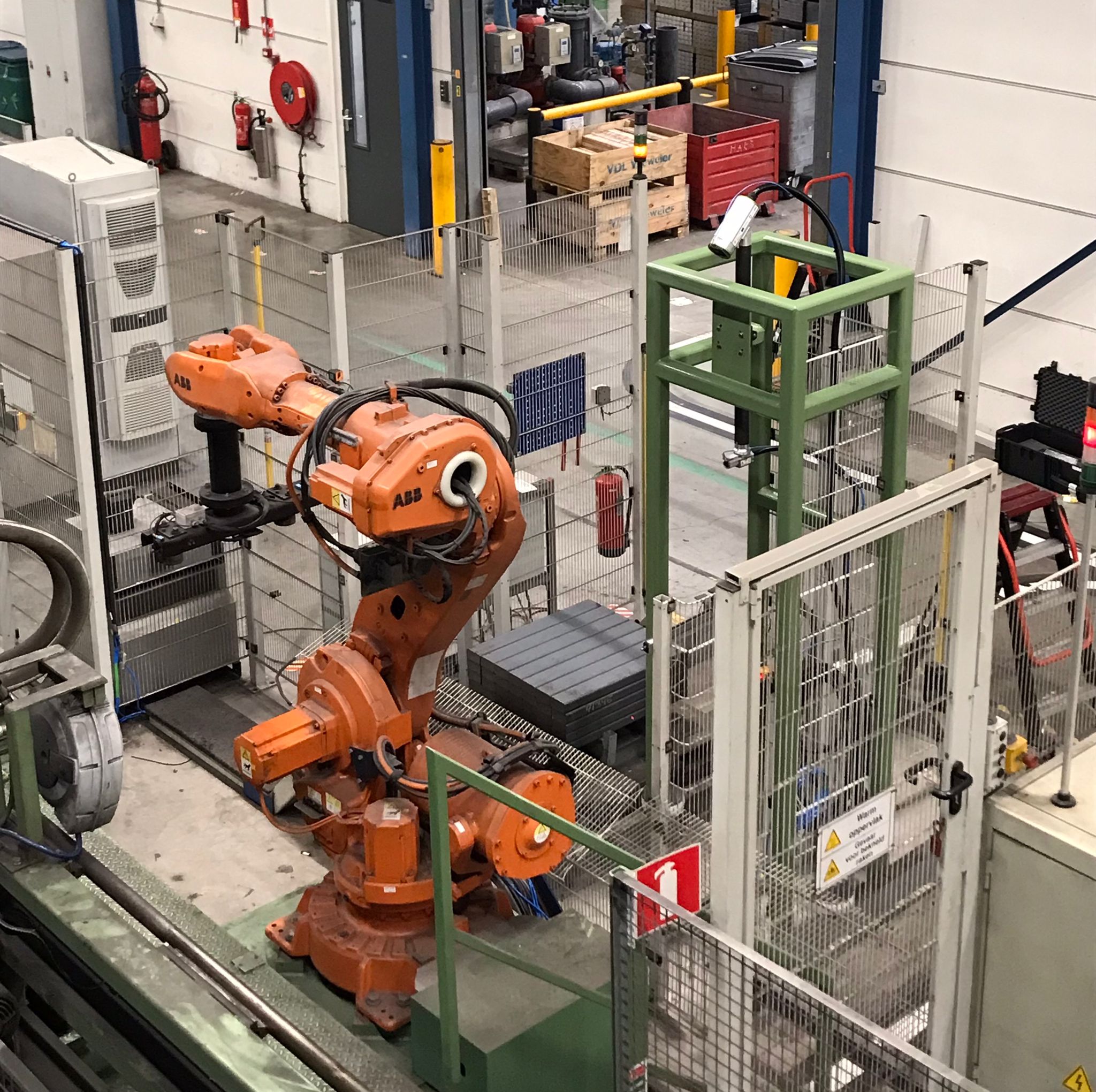
The Laser Line Triangulation (LLT) system is a solution developed for measuring geometric characteristics in the steel processing industry tailored to inspect steel bars at the beginning of the process and measure their straightness. The system measures the geometric profile Z(X) over the laser line and has been designed in order to guarantee a wide measurement range which covers an X-FOV between 800÷2000 mm. While covering a particularly large measurement range, the sensor maintains a good resolution in Z direction reaching Z-resolution up to 0.02 mm with subpixel interpolation, in order to meet the specifications, set by the in-line application. The sensor incorporates a 3D smart camera with embedded laser line extraction algorithms and a laser line projector including colling modules and carbon-based supports in order to keep stable the sensor performances in the harsh industrial environment. The software is able to trigger a synchronized measurement with the PLC of the robot that positions the bar for inspection. The data is analysed to extract critical information such as the bar straightness which is outputted in JSON format and shared to the online platform via MQTT communication protocol and provides insights into product quality and geometric characteristics, supporting improved process efficiency.
Benefits
- Wide measurement range which allows adaptation to inspect different product geometries.
- High Z-resolution which allows accurate measurement in case of restrictive tolerance requirements.
- Fast inspection of a product given low-time data acquisition and processing.
- Reliable identification of product non-conformity to the geometric requirements.
- Reliable operation in high-temperature and harsh environment.
Key stakeholders
- STEEL INDUSTRY
Contact
NDI#1 has been developed by the DIISM Department at UNIVPM. Email [email protected] for more information.
Pictures & videos
NDI #2
Thermographic Non-Destructive system for high-temperature steel bar Inspections
LEADING PARTNER
ASSOCIATED PARTNER: VDLWEW
Description
The NDI system uses a thermal camera to acquire two thermal images of a high-temperature steel bar before the descaling of the VDLWEW factory. Multiple images are stitched together, and thermal correction is applied, to reconstruct the full image of the bar. The system inspects 100% of the product in real-time, capturing the surface temperature distribution. The output of the NDIs consists of temperature distribution information, to detect product anomalies and verify induction furnace effectiveness, and oxide scales information, to identify descaling unit effectiveness and its energy consumptions. Descaling process diagnosis can be conducted in a synergistic manner with the NDI installed after the descaling unit. Self-diagnostic strategies have been studied and implemented: in this way, the NDI is able to survive and function efficiently in a hostile environment.
Benefits
- Reliable identification of product anomalies and valuable insights into process irregularities, enabling potential improvements.
- Reliable operation in high-temperature and harsh environment.
- Simple hardware and low processing requirements.
Key stakeholders
- STEEL PRODUCERS AND ROLLING MILLS
- HIGH-TEMPERATURE STEEL INDUSTRY
Purpose
This NDI system enables real-time thermal inspection of hot steel bars with single-shot imaging, in a harsh environment. It is designed for continuous monitoring of the production process, ensuring early identification of defects. It helps in reducing waste and optimizing production efficiency.
Contact
NDI#2 has been developed by the DIISM Department at UNIVPM. Email [email protected] for more information.
Pictures & videos
LEADING PARTNER
ASSOCIATED PARTNER: VDLWEW
Description
The Laser Line Triangulation (LLT) system is a solution developed for measuring geometric characteristics in the steel processing industry tailored to inspect steel bars at extreme temperatures, at which the bar is incandescent. The sensor incorporates a 3D smart camera with embedded laser line extraction algorithms and a laser line projector and measures the geometric profile Z(X) over the laser line. It has been designed to guarantee a wide X measurement range up to 2000 mm and high Z-resolution up to 0.02 mm with subpixel interpolation. The application at the hot stage is challenging as the hot surface does not allow an adequate signal-to-noise ratio for a precise measurement. The sensor has been therefore equipped with custom optics and protections for harsh environments and tailored software solutions which allow to pre-process the data enhancing the signal to noise ratio and thus allowing to perform a measurement in such critical conditions. This solution ensures greater accuracy and efficiency in quality control processes, inspecting the product at a stage where no other control techniques can be applied, thus providing valuable insights into the production process and product geometric features.
Benefits
- Inspection of the product at extreme temperatures and reliable operation in harsh environment.
- Wide measurement range which allows adaptation to inspect different product geometries.
- High Z-resolution which allows accurate measurement in case of restrictive tolerance requirements.
- Reliable identification of product non-conformity to the geometric requirements.
- Fast inspection of a product given low-time data acquisition and processing.
Key stakeholders
- STEEL INDUSTRY
Purpose
The Laser Line Triangulation sensor can be used for real-time geometric inspection of products at hot stage monitoring 100% of production process and enabling for fast defect identification, in order to prevent defect propagation along the production line. The sensor can be installed in harsh industrial environments and inspect a wide variety of products maintaining stable its performances and guaranteeing and accurate resolution also given the high temperature of the surface inspected. The software is flexible to extract different features of the products such as straightness, length or other types of deformations.
Contact
NDI#3 has been developed by the DIISM Department at UNIVPM. Email v.pasquinelli@staff.univpm.it for more information.
NDI #4
Thermographic Non-Destructive system for high-temperature steel bar Inspections
LEADING PARTNER
ASSOCIATED PARTNER: VDLWEW
Description
The NDI system uses a thermal camera to acquire a thermal image of a high-temperature steel bar after the descaling unit of the VDLWEW factory. The system inspects 100% of the product in real-time, capturing the surface temperature distribution. The output of the NDIs consists of temperature distribution information, to detect product anomalies and verify induction furnace effectiveness, and oxide scales information, to identify descaling unit effectiveness and its energy consumptions. Descaling process diagnosis can be conducted in a synergistic manner with the NDI installed before the descaling unit. Self-diagnostic strategies have been studied and implemented: in this way, the NDI is able to survive and function efficiently in a hostile environment.
Benefits
- Reliable identification of product anomalies and valuable insights into process irregularities, enabling potential improvements.
- Fast acquisition and process of a thermal image to guarantee fast inspection of a product.
- Reliable operation in high-temperature and harsh environment.
- Simple hardware and low processing requirements.
Key stakeholders
- STEEL PRODUCERS AND ROLLING MILLS
- HIGH-TEMPERATURE STEEL INDUSTRY
Purpose
This NDI system enables real-time thermal inspection of hot steel bars with single-shot imaging, in a harsh environment. It is designed for continuous monitoring of the production process, ensuring early identification of defects. It helps in reducing waste and optimizing production efficiency.
Contact
NDI#4 has been developed by the DIISM Department at UNIVPM. Email [email protected] for more information.
NDI #5
Laser triangulation system for 3D dimension measurement of finished trailing arms
LEADING PARTNER
ASSOCIATED PARTNERs: VDLWEW, LMS
Description
The measurement system consists of an industrial robot used to handle and position the part, a linear guide, an incremental encoder, and a laser line triangulation sensor. The setup is supported by two personal computers: one dedicated to data acquisition and the other to data processing. During operation, the data acquisition system generates a point cloud of the measured component by scanning it with the laser line triangulation sensor while it is moved by the linear guide. The processing software subsequently aligns the acquired point cloud with a reference numerical model derived from the CAD representation of the product. Once alignment is achieved, the required geometrical features are extracted from the aligned point cloud.
Benefits
- Geometrical measurement of products at extreme temperatures and in harsh environments.
- Wide measurement range which allows adaptation to inspect different product geometries.
- High Z-resolution which allows accurate measurement in case of restrictive tolerance requirements.
- Reliable operation in high-temperature and harsh environment.
- Simple hardware and low processing requirements.
Key stakeholders
- STEEL FORMING PRODUCERS
- METAL PARTS MANUFACTURERS
- SYSTEM INTEGRATORS
Purpose
This NDI system enables rapid geometric reconstruction of 3D object point clouds within a few tens of seconds. A dedicated point cloud processing software facilitates the extraction of specific geometrical features, such as hole diameters, interaxial distances, and various other dimensional parameters. The system contributes to waste reduction and enhances overall production efficiency.
Contact
NDI#5 has been developed by the DIISM Department at UNIVPM. Email [email protected] for more information.
LEADING PARTNER

Description
This NDI system enables automated visual inspection to detect surface defects and irregularities on products or parts directly within the production line. It uses high-resolution cameras, controlled lighting, and advanced computer vision algorithms to continuously monitor each component without interrupting the manufacturing process. The system is flexible and can be adapted to detect a wide range of imperfections depending on the specific application, ensuring consistent quality control and reducing the need for manual inspection. Integration with existing automation systems provides immediate feedback and data logging for process optimization and full traceability.
Benefits
- Automated traceability of every manufactured product.
- Automated defect detection of products.
- Easy integration with existent hardware.
- Flexible and adaptable to the specific use-case.
Key stakeholders
- MANUFACTURING INDUSTRIES
Purpose
- Quality assurance and process control: The inspection results can be used to automatically verify product quality, detect deviations early, and ensure compliance with manufacturing standards.
- Root-cause analysis and process optimization: Collected data can help identifying recurring patterns and optimize production parameters to reduce waste and improve efficiency.
- Traceability and documentation: Inspection records provide a digital audit trail for each part, supporting traceability requirements and facilitating reporting or certification processes.
Contact
NDI#6 has been developed by AIMEN. Email [email protected] for more information.
NDI #7
IIoT portable laser line triangulation sensor for gap and flush measurements (G3F)
LEADING PARTNER

ASSOCIATED PARTNERs: VWAE, UNIVPM
Description
The G3F is a handheld, wireless, and ergonomic optical instrument based on laser profilometry for the non-contact measurement of geometric profiles, to be used by the operators in different applications, among which the measurement of gap and flush in the final assembly of cars. Laser line triangulation is an existing technology, but its implementation in a miniaturized and portable form is innovative. Moreover, the device is equipped with a series of auxiliary sensors, such as: a RGB color sensor; a bar/QR code reader and an infrared distance sensor which allow improved performances and easy integration in the production environment. A System on Module integrated with custom electronics manages the device and its functionalities supported by a proprietary SW application. In particular, AI algorithms have been embedded on edge to reduce the metrological uncertainty of the measurements on different materials, such as reflective metal, plastics and glass. The G3F has been fully integrated in the openZDM platform, exchanging data through a MQTT protocol using the Wi-Fi embedded in the device, making the acquired data available for further analysis. In this way, the fully digitalization of the Gap & Flush quality control performed by the operators in production line has been reached.
Benefits
- Portable, Precise and Repeatable measuring instruments, capable of integrating data with corporate quality management systems.
- Technologies that reduce the margin of human error and increase control efficiency.
- Ease of use and quick training for the team.
- Integration with IIoT and Industry 4.0 systems for real-time data analysis and complete traceability of measurements.
Key stakeholders
- AUTOMOTIVE OEM
- AUTOMOTIVE TIER 1
- SYSTEM INTEGRATORS
Purpose
The range of applications of the G3F as portable laser line profilometer are many and diversified. As example we could mention:
- quality control tasks in production line;
- measurements of profiles for maintenance purpose;
- measurements of geometrical characteristics for pilot production.
Contact
U-Sense.IT will produce and commercialize the G3F following a B2B business model. Email [email protected] for more information.
NDI #8
Deep learning model for the thickness estimation of glass bottles in hot area
LEADING PARTNER

ASSOCIATED PARTNER: VIDRALA
Description
The deep learning based model has been designed, developed and trained to estimate the wall thickness of a bottle at three different heights based on two thermal images that cover partially the surface of the bottle. This model has the potential to provide an estimation of the defined quality indicators in the bottle body to enable the system to remove the defective bottles as soon as those are formed instead of waiting until quality inspection is carried out at the end of the line, 45 to 75 minutes later. A pipeline has been designed and developed with the following stages. Once the acquisition is done (two pictures of the same bottle are taken by different cameras at two different positions), bottle contour segmentation is done in both images, rescaling is done, and the final composed image is obtained with both images. The composed image is the input of the model. The outputs of the model are three wall thickness values, everyone being measured at a different height. The proposed approach is a regression model. Finally, a residual compensation with process data is applied to the model to compensate process drift. The characterization by the bottle reference was required to generate valuable database to train the model and initial validation of the proposed solution. Final model was trained with 182118 bottles, validated with 20213 and tested with 193608 bottles. The trained model achieved very good metrics over the testing subset for the three thickness values, that constitute the output of the model. Thickness at the bottom inspection point was estimated with a R2 (Pearson’s coefficient of correlation) between 0.9 and 0.92; thickness at the top inspection point was estimated with a R2 between 0.78 and 0.82; and thickness at the medium inspection point was estimated with a R2 between 0.66 and 0.75. In all the inspection heights, MAE (Mean Absolute Error) ranges from 0.04 to 0.07 mm, which is very good. The model has been validated only over one bottle reference. Further analysis should be done to guarantee the scalability of the solution to other bottle references, of different shapes and diameters. We think that the approach is robust enough for this generalization capability.
Benefits
- Inspection of a product at high temperatures (1250ºC to 750ºC).
- Adaptation to different models and bottle characteristics.
- Fast inspection that avoids defective product in the line.
- Strategies to train the model and later compensate the output for possible process drift have been successfully designed and validated.
Key stakeholders
- GLASS MANUFACTURERS
- Other industries with large productions and fast velocity lines can use the same kind of deep learning-based approaches to inspect some features of their products and guarantee their quality.
Purpose
The deep learning model for bottle thickness estimation can be used for process inspection of bottle in the hot area, allowing to check 100% of production before arriving to the quality control inspection at the end of the line.
Contact
Developed by TECNALIA. Email [email protected] and [email protected] for more information.
LEADING PARTNER

Description
IR thermal camera system for in-line monitoring of welding defects, operational at the APTIV facility. The system is specifically dedicated to the detection of electrical resistance defects: to assess a poor quality in electrical conductivity of the joint the complete video of the process and cooling-down phase is analyzed. The system consists of 10 FLIR A35 cameras connected to an Elaboration Unit (EU) via a Gigabit PoE switch. The EU processes image data with industrial-grade hardware, including an Intel Xeon CPU, 32GB RAM, and NVIDIA RTX 2070 GPU. A server PC stores processed data, videos, and maintains a database for access by the DMS and PLC. A KVM console provides centralized control, and a UPS ensures 15 minutes of backup power during outages. The software architecture enables real-time defect detection. The robot triggers cameras to capture thermal images of welding processes, with traceability data for identification. The videos are pre-processed by the EU and analyzed by AI algorithms to assess weld quality. The results are saved on the server, shared with PLCs to optimize production, and sent to the OPENZDM integrated platform using MQTT in JSON (AAS) format.
Benefits
- High improvement in welding process quality.
- Non-invasive automated assessment and control of welded joints, without affecting cycle time or manufacturing layouts.
- Easy assessment of welded joints quality before final assembly, ensuring battery integrity and preventing waste.
- Fast inspection that avoids defective product in the line.
- Strategies to train the model and later compensate the output for possible process drift have been successfully designed and validated.
Key stakeholders
- Battery manufacturing companies
- OEM Car Manufacturers
- Other manufacturing industries
- General Industry
- EV manufacturers and EV supply chain
- Components suppliers
- System integrators
Purpose
This novel and advanced monitoring system is dedicated to the quality improvement in complex welding processes, in automotive and also other manufacturing sectors, with a specific focus on battery production. The NDI system uses thermal imaging and artificial intelligence to perform non-invasive automated assessment and control of welded joints, without affecting cycle time or manufacturing layouts. In principle it can be used in virtually all processes where precision welding operations are required. The specific use is related to welded joints assessment (mechanical/electrical resistance) with a 91% of accuracy.
Contact
Developed by COMAU. Email [email protected] , [email protected] and [email protected] for more information.
An implementation of the result is available in APTIV Battery Manufacturing site. The preferred selling model is the direct delivery and installation of the NDI at customer’s site.
LEADING PARTNER
ASSOCIATED PARTNERS: LMS, APTIV
Description
The NDI consists of a 2D camera system for in-line monitoring of welding processes, fully operational at the APTIV facility. It inspects mechanical and positioning defects before welding and identifies mechanical, missing welds, and hole presence after welding. The system comprises multiple 2D cameras connected to a Power Over Ethernet (PoE) switch linked to a Linux PC for data processing. Communication with the PLC occurs via the OPC-UA protocol for synchronized acquisition and control without interfering with cycle time. The data is formatted in JSON (AAS) and sent via MQTT to the OPENZDM integrated platform. The software manages image acquisition, defect detection, and feature extraction using advanced object detection models (YOLOv8). The key components include an image splitting service, weld area and extraction models, an XAI layer for explainable AI with Grad-CAM annotations, and a visualization service for operator interaction. Technologies used include Python, JavaScript, Flask, Node-RED, PyTorch, and PostgreSQL, with Docker ensuring containerization. The integration with the openZDM platform involves updating the AAS with OK/NOK results, sending defect notifications, and embedding the visualization service via IFRAME for real-time monitoring and operator alerts.
Benefits
- Effective welding quality monitoring dedicated to aesthetical defects.
- Easy identification of mechanical and positioning defects before welding and identification of mechanical, missing welds and hole presence after welding
- High improvement of process quality related to complex welding operations
- Fast inspection that avoids defective product in the line.
- Strategies to train the model and later compensate the output for possible process drift have been successfully designed and validated.
Key stakeholders
- Battery manufacturing companies
- OEM Car Manufacturers
- Other manufacturing industries
- General Industry
- EV manufacturers and EV supply chain
- Components suppliers
- System integrators
Purpose
The NDI can be used for in-line monitoring of manufacturing processes, with specific focus on high precision welding operations typically associated to EV battery manufacturing but with possible applicability in many other manufacturing areas. The system allows effective proactive process monitoring with classification accuracy over 89% and detection precision over 99%.
Contact
Developed by COMAU. Email [email protected] , [email protected] and [email protected] for more information.
An implementation of the result is available in APTIV Battery Manufacturing site. The preferred selling model is the direct delivery and installation of the NDI at customer’s site.